Meric
A Unified Framework for Multimodal Music Generation and Retrieval via Representation Space Anchoring
Accepted to ECCV 2026.
Project page | Model weights | Documentation | Reproducibility | Roadmap
Meric generates 44.1 kHz music from images, videos, and text.
It maps every input modality into a shared MuQ music representation, then renders that representation with a flow-matching audio decoder.
The same anchored representation is used for the paper’s cross-modal retrieval experiments.
From images to music
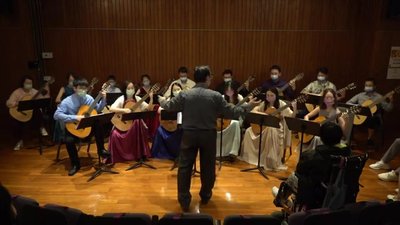
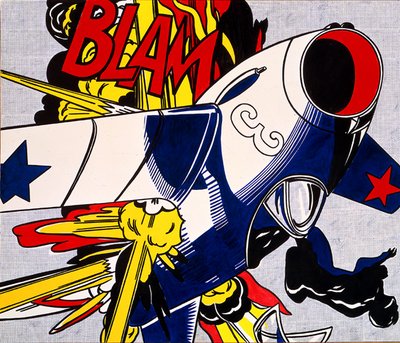
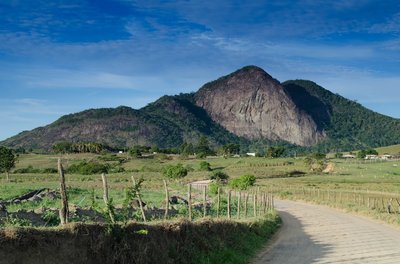
| Guitar ensemble | Pop art | Mountain landscape |
|---|
 |  |  |
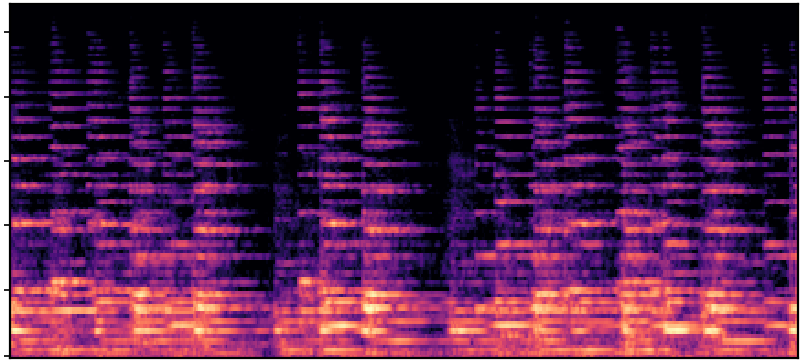 | 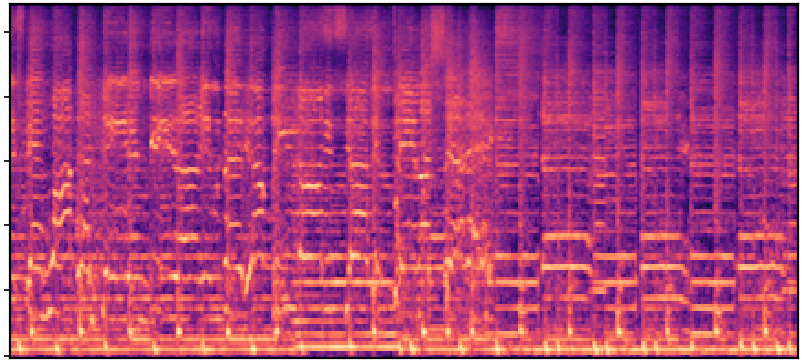 | 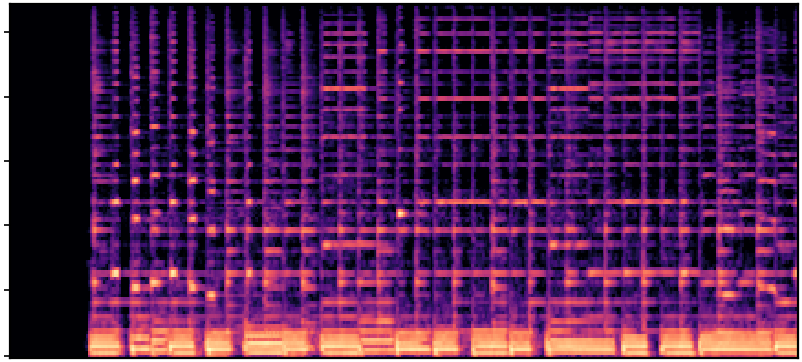 |
Input images above, Meric-generated mel spectrograms below (10 seconds, 44.1 kHz), reproduced from the paper’s qualitative examples.
Listen to generated music on the project page, including multiple musical interpretations of one image.
Framework
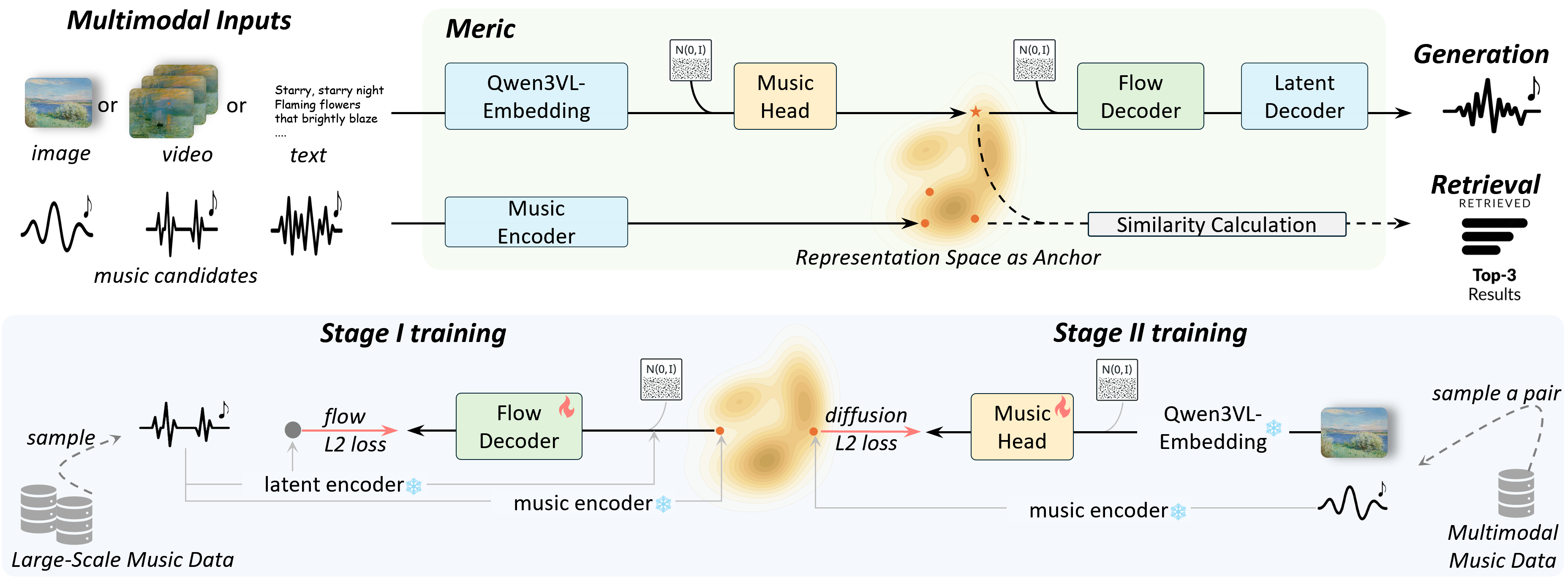
The Music Head makes the cross-modal mapping stochastic, which represents the one-to-many relationship between a visual or textual prompt and plausible music.
The acoustic decoder can be trained with unpaired music because it consumes the shared MuQ representation rather than the original modality.
The figure numbers the training phases: acoustic decoder first, Music Head second.
Release status
The repository currently supports pinned pretrained inference, Music Head training with prepared inputs, exact camera-ready result tables, and partial Flow Decoder training-code inspection.
Full paper retraining and table regeneration additionally require data and evaluation artifacts that are not yet public.
Unchecked work is tracked in the public roadmap, while correctness, licensing, and launch gates are tracked in the maintainer release checklist.
An unchecked roadmap item must not be interpreted as an available artifact or a promised release date.
Installation
Meric is tested with Python 3.10, PyTorch 2.5.1, and CUDA 12.1 on Linux.
Model downloads require roughly 30 GB of free disk space.
git clone https://github.com/Audiofool934/meric.git
cd meric

python3.10 -m venv .venv
source .venv/bin/activate

pip install torch==2.5.1 torchvision==0.20.1 torchaudio==2.5.1 \
    --index-url https://download.pytorch.org/whl/cu121
pip install -e .
The released Music Heads use Qwen3-VL-Embedding in a separate Python 3.11 environment because its dependency versions conflict with the audio runtime.
The setup helper checks out the tested upstream revision and downloads the tested 2B embedding model revision.
python -m pip install uv==0.9.26
bash scripts/setup_qwen3vl.sh
export QWEN3VL_REPO="$PWD/.external/Qwen3-VL-Embedding"
See docs/SETUP.md for Conda, offline setup, environment overrides, and troubleshooting.
Quick start
Weights are downloaded from Audiofool/meric on first use and are pinned to an immutable Hub revision.
Generated files include a manifest.json with seeds, settings, input and output checksums, and upstream model revisions.
meric generate --image examples/images/sample_sunset.jpg --output-dir outputs/image
meric generate --text "A calm piano melody with gentle rain" --output-dir outputs/text
meric generate --video path/to/clip.mp4 --video-max-frames 8 --output-dir outputs/video
meric generate --image examples/images/sample_ocean.jpg -n 3 --seed 42 --output-dir outputs/variants
meric models
Python API:
from meric import MericPipeline

pipe = MericPipeline.from_pretrained("meric-sft-v3", device="cuda:0")

image_wavs = pipe.generate(image="photo.jpg", n=3, seed=42, output_dir="outputs/image")
text_wavs = pipe.generate(text="lo-fi piano in the rain", output_dir="outputs/text")
video_wavs = pipe.generate(video="clip.mp4", video_max_frames=8, output_dir="outputs/video")
For an exact variant set, pass seeds=[7, 11, 23] to pipe.generate.
A direct MuQ input is also supported with muq=<numpy array or .npy path>.
See docs/USAGE.md for all inference options and the supported training commands.
Released checkpoints
| Model | File | Purpose |
|---|
meric-sft-v3 | rdm_sft_v3.pth | Camera-ready paper Music Head and default model |
meric-instrumental | rdm_sft_instrumental.pth | Music Head fine-tuned for instrumental output |
| Shared Stage 2 | mericldm.ckpt | MuQ-conditioned flow decoder used by both Music Heads |
Exact byte sizes, SHA-256 checksums, Hub revisions, and upstream component revisions are recorded in docs/MODELS.md.
No model weights are stored in Git.
The source code is Apache-2.0, but the released Stage-2 checkpoint derives from Stable Audio Open and also serializes frozen MuQ-MuLan parameters.
It is therefore subject to the Stability AI Community License and the MuQ weight license, CC BY-NC 4.0.
Review NOTICE before redistribution or commercial use.
Camera-ready results
The following values are transcribed from the final camera-ready tables.
Lower FAD and KL are better, while higher Sem is better.
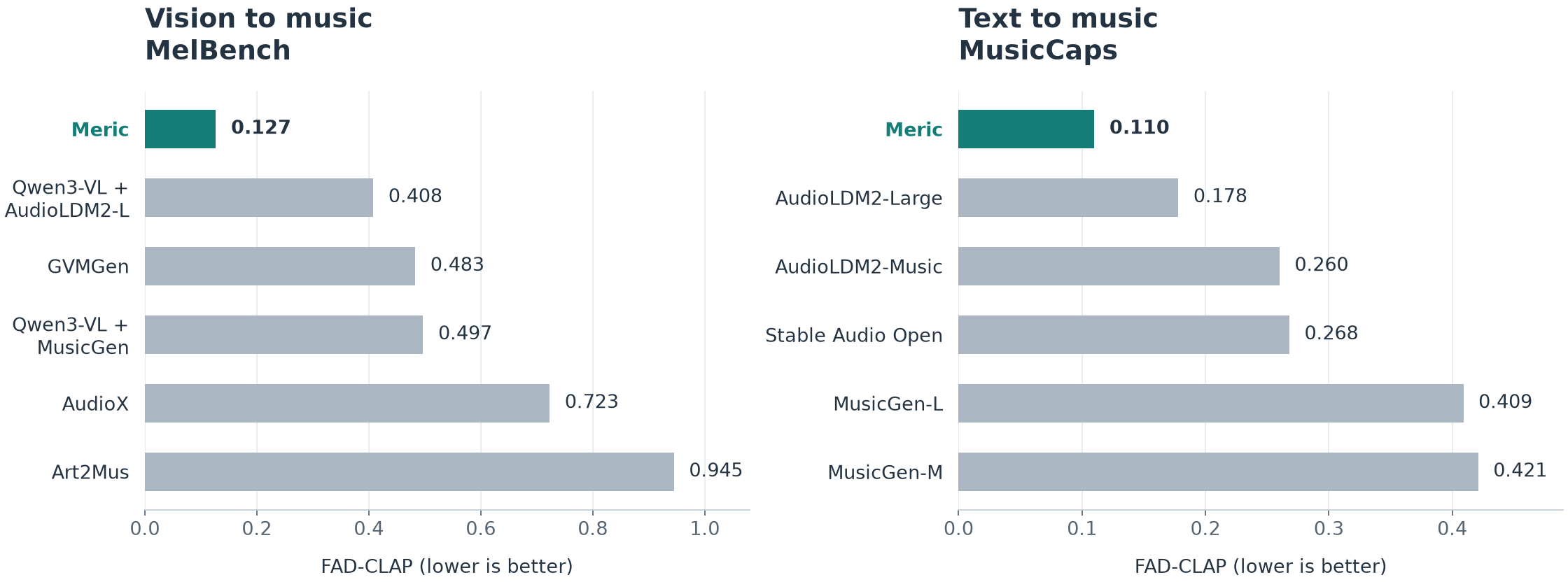
Selected vision-to-music and text-to-music benchmarks, showing every baseline from the corresponding camera-ready tables.
The complete results across datasets and metrics are in docs/RESULTS.md.
Vision-to-music generation
| Dataset | FAD-MERT | FAD-CLAP | FAD-VGG | KL-MERT | Sem |
|---|
| MelBench | 1.55 | 0.127 | 1.27 | 0.0059 | 74.7 |
| MuImage | 1.79 | 0.169 | 3.20 | 0.0078 | 87.1 |
| EmoMV | 3.06 | 0.253 | 2.45 | 0.0060 | 81.0 |
| ARIA | 3.30 | 0.247 | 2.08 | 0.0055 | 79.6 |
Text-to-music generation
| Dataset | FAD-MERT | FAD-CLAP | Sem |
|---|
| MusicCaps | 1.87 | 0.110 | 74.2 |
| ARIA | 2.14 | 0.155 | 74.5 |
Complete generation, retrieval, baseline, and ablation tables are in docs/RESULTS.md.
The evaluation protocol and exact public artifact boundary are described in docs/REPRODUCIBILITY.md.
Repository layout
meric/             Installable package, public API, model code, and inference engine
scripts/           Supported training scripts and release verification helpers
tests/             CPU unit and smoke tests
docs/              Setup, usage, architecture, model, result, and data documentation
examples/          CC0 sample inputs
The stable user surface is meric.MericPipeline and the meric command.
Internal experiment histories, incomplete post-submission work, and environment-specific baseline adapters are maintained in the private research repository rather than presented as supported public code.
Data
Stage 1 is pretrained on 369K cross-modal pairs drawn from AudioSet-Music, MelBench, and EmoMV after YouTube-ID deduplication, then fine-tuned on ARIA.
ARIA contains 5K images with generated captions and instrumental music, using a 4K/1K train/test split.
Dataset availability, preparation, and third-party terms are documented in docs/DATA_INVENTORY.md and NOTICE.
Citation
@inproceedings{wang2026meric,
  title     = {Meric: A Unified Framework for Multimodal Music Generation and Retrieval via Representation Space Anchoring},
  author    = {Wang, Xihua and Wang, Yinbo and Zhang, Jingchao and Song, Ruihua},
  booktitle = {European Conference on Computer Vision},
  year      = {2026}
}
Xihua Wang, Yinbo Wang, and Jingchao Zhang contributed equally.
Ruihua Song is the corresponding author.
Proceedings pages, DOI, and the arXiv identifier will be added when those records are available.
License
The repository source code is licensed under the Apache License 2.0.
Model weights, datasets, and upstream components retain their respective licenses and are not relicensed under Apache-2.0.
See NOTICE for the complete attribution and license summary.